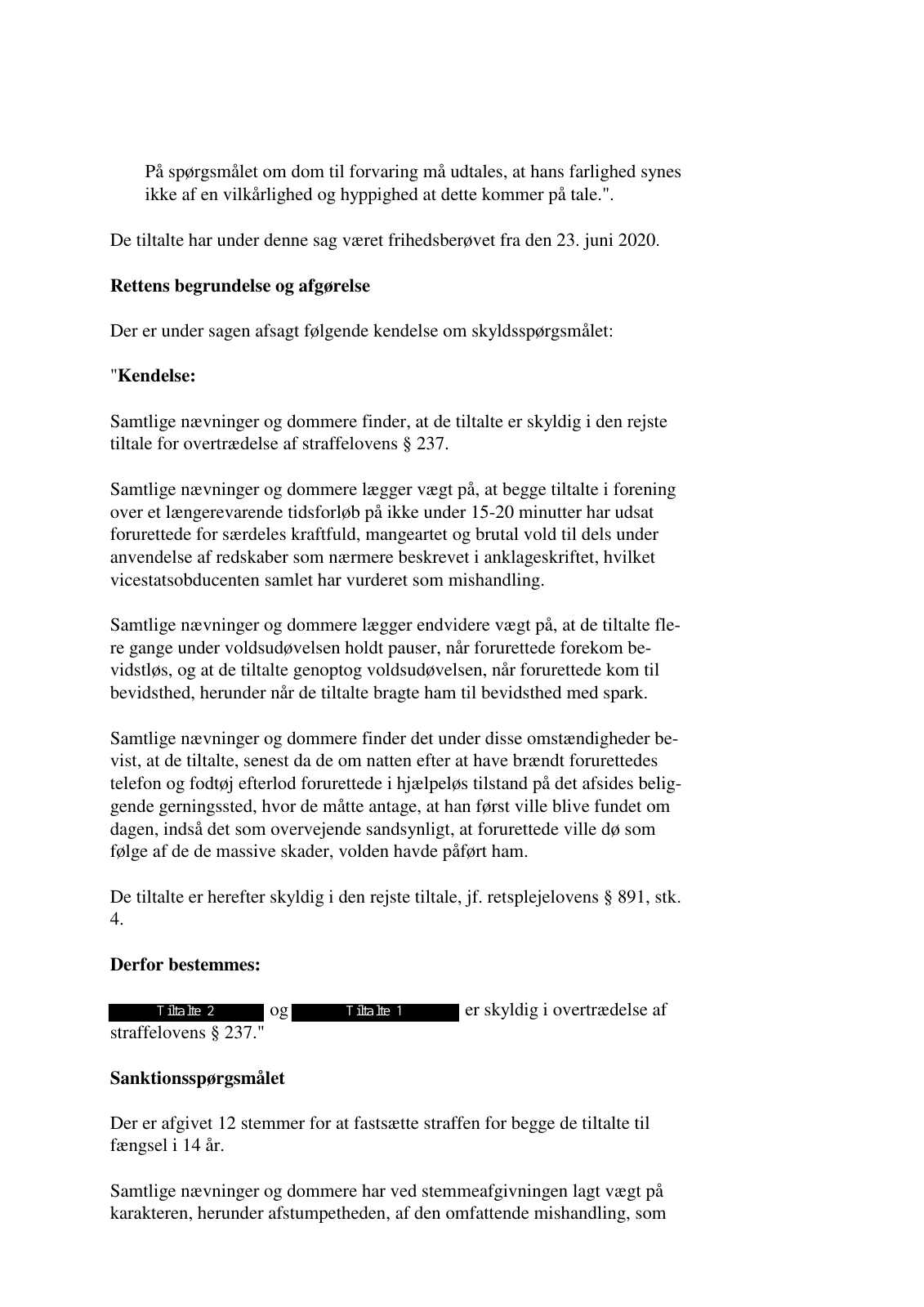
White killers kicked a Black man awake and continued beating him.
Section 1 of 9 · Introduction
White killers kicked a Black man awake and continued beating him.
The murder convictions stand. The published judgments contain no explicit determination of racial motive. The family’s questions deserve a hearing, and the court record deserves accurate attribution.
By Al Agami · XORCIS.AI · 7 October 2026
Phillip Mbuji Johansen was 28. He was a Black Danish man with Tanzanian heritage. His body was found in a forest on Bornholm on 23 June 2020. Two White brothers who knew him, Mads and Magnus Møller, were convicted of his murder. The trial court sentenced both to 14 years on 1 December 2020. Østre Landsret upheld the murder convictions and increased both sentences to 15 years on 28 October 2021. [1][2][3][7]
The trial court found that the brothers inflicted brutal violence over at least 15–20 minutes. The judgment records pauses when Johansen appeared unconscious and renewed violence when he regained consciousness, including when kicks brought him round. The court found that, by the time the brothers left him helpless at the isolated scene, they understood that his death was overwhelmingly likely. [1]
His life must not disappear behind the argument about how to classify his death. Before this became a dispute about Denmark, it was the killing of Phillip.
The invention examined here is a tempting shortcut in public language: letting an account of a judgment acquire more certainty than the judgment’s published reasoning supplies.
That shortcut offers certainty without earning it. Its opposite is equally dangerous: treating evidence that raises suspicion as proof of the entire accusation.
This article argues for keeping the space between those claims open. A criminal finding has a specific job. Public scrutiny has a responsibility to describe that finding accurately and ask what its limits leave unresolved.
In July 2020, prosecutor Bente Pedersen Lund told AFP that the killing arose from a personal relationship and was not racially motivated. The prosecution said it had considered the possibility of racism, but declined to explain its reasoning publicly while the investigation was confidential. Afro Danish Collective questioned how quickly that possibility had been ruled out. [3]
Euronews with AP later reported that the appeal court found insufficient evidence of a racist motive. The published appeal judgment confirms guilt and increases the sentences, but its stated reasoning contains no explicit determination of racial motive. This article therefore attributes the former claim to the news report, rather than presenting it as wording established by the judgment. [2][6]
The problem for a reader is practical. An assurance is available; the supporting reasoning is not. Confidentiality may explain that gap. It does not allow the reader to inspect what remains withheld.
An institution asking for confidence should recognise the difference between announcing its conclusion and making that conclusion understandable. Otherwise, the public is left arguing over who deserves belief rather than examining what supports the claim.
The family’s lawyer, Tyge Trier, told the appeal court that Johansen’s parents believed racism might have played a role. He linked their concern to the extreme violence and the apparent disregard for Phillip as a person. [4] The trial judgment records a defendant’s account of his swastika and “White Power” tattoo. He said it was intended as provocation and denied being racist. He also described an argument at a party shortly before the murder after Johansen drew attention to the tattoo. These are attributed statements in the testimony, not independent findings that establish the motive for the killing. [1]
A tattoo can raise a serious question about motive without answering it. Likewise, knowing the victim does not logically exclude racial hostility.
The brothers claimed a personal grievance involving an alleged sexual assault against their mother. That was their account, not an established fact about Johansen. A defendant’s explanation for violence must remain distinguishable from the court’s reasons for finding murder proved. [1][2]
Accuracy also requires correcting errors on the other side of the argument. TjekDet documented mistaken reporting that attributed far-right associations to both brothers when the relevant material concerned the older brother. It also challenged an international report’s comparison of Danish hate-crime figures collected under different methods. Those errors cannot responsibly be used to strengthen this case. [5]
The reporting establishes murder convictions and punishment. It records a family’s concern about racism and testimony about a racist tattoo. The published judgments’ stated reasons establish guilt and punishment without explicitly determining racial motive.
It does not establish a concealed racist motive or a deliberate cover-up. Nor should the verdict be recruited as a certificate of Denmark’s innocence on every question of racism.
The demand here is for precision: identify the finding, explain the evidence, acknowledge the uncertainty. Phillip’s death should not become raw material for anyone’s preferred national story.
What is answered, and what remains open. Question 3 is answered above: the judgments establish murder and punishment, but contain no explicit determination of racial motive. Questions 1 and 2 remain partly open. The article records the tattoos, testimony and family concerns; it does not possess a complete public account of the motive investigation.
- What evidence supported the early rejection of a racial motive? What reasoning can now be made public?
- How were the tattoos and the family’s concerns assessed? What explanations were tested, and what did that examination establish?
- What exactly does the verdict settle? Can we describe its limits without converting suspicion into guilt or uncertainty into reassurance?
A verdict is a finding, not a national character reference.
Sources
- [1] Retten på Bornholm, judgment of 1 December 2020, case 1-760/2020, especially testimony and the court’s reasons.
- [2] Østre Landsret, 3rd division, judgment of 28 October 2021, S-3463-20. ECLI:DK:OLR:2021:SS0000000085.
- [3] AFP/The Local, Danish prosecutors deny murder of young Black man racist, 3 July 2020.
- [4] Ritzau/The Local, Parents of Bornholm killing victim see racism in crime, 27 October 2021.
- [5] TjekDet, fact-check of international reporting on the Bornholm murder, 2 July 2020.
- [6] Euronews with AP, Danish brothers who murdered biracial man have sentences increased, 28 October 2021.
- [7] Katrine Dirckinck-Holmfeld, Entangled Archives: Reparative Critical Practices in Situations “Beyond Repair”, The Nordic Journal of Aesthetics, printed p. 56. Used for the description of Johansen and his killers; its broader interpretation is not a judicial finding.
Source note: the published trial and appeal judgments were reviewed directly. The PDF copies are anonymised or pseudonymised court documents. Testimony, prosecutorial statements, news reporting and judicial findings are identified separately. No finding of a racist motive or a cover-up is asserted.