Meat is murder.
Denmark counts pigs slaughtered and pigs exported. Its authorities also count welfare violations. “Meat is murder” is the moral accusation examined here, but the Danish pork industry supplies a more specific documentary trail: docked tails, carbon dioxide stunning and millions of animals moving through a business built around their bodies.
In an April 2024 parliamentary reply, the Danish authorities stated that most pigs slaughtered in Denmark were stunned with CO₂. [8] EFSA’s 2020 assessment identifies high-concentration carbon dioxide stunning of pigs as a serious welfare concern. Before unconsciousness, the gas can cause pain, fear and respiratory distress. Loss of consciousness is not immediate. Gasping and attempts to retreat or escape are among the responses discussed. This suffering can arise from the method itself; it cannot all be assigned to a worker mishandling the equipment. [2]
In January 2024, the Danish Veterinary and Food Administration reported that about 95 percent of pigs arriving at Danish slaughterhouses had docked tails. In a documentation inspection of 400 herds, 30 percent of the farmers received sanctions in the form of one or more formal warnings; the authority also reported one order and four police referrals. This was an inspection result, not a national estimate that 30 percent of all pig farmers violated the rules. [3]
In Denmark, the preliminary figures for April–June 2026 record 3.727 million pigs slaughtered. Another 4.244 million live pigs were exported, of which 4.128 million were piglets, mainly destined for Poland and Germany. Those exports are not additional Danish slaughter deaths. They show why a national slaughter count does not capture the whole production chain. [5]
The invention examined here is the administrative conversion of a pig into an acceptable product. The same animal becomes a piglet sold abroad, a slaughter pig delivered to an abattoir, a carcass and a quantity of pork. Each category helps a business operate. None, by itself, tells the buyer what the animal experienced.
“Meat is murder” challenges the permission to kill animals for food. It is an ethical position, not a report that ordinary regulated slaughter has been judicially classified as murder. This article’s argument is that legal permission does not settle whether the killing is justified. The factual questions concern what happens; the moral question concerns what we are prepared to authorize.
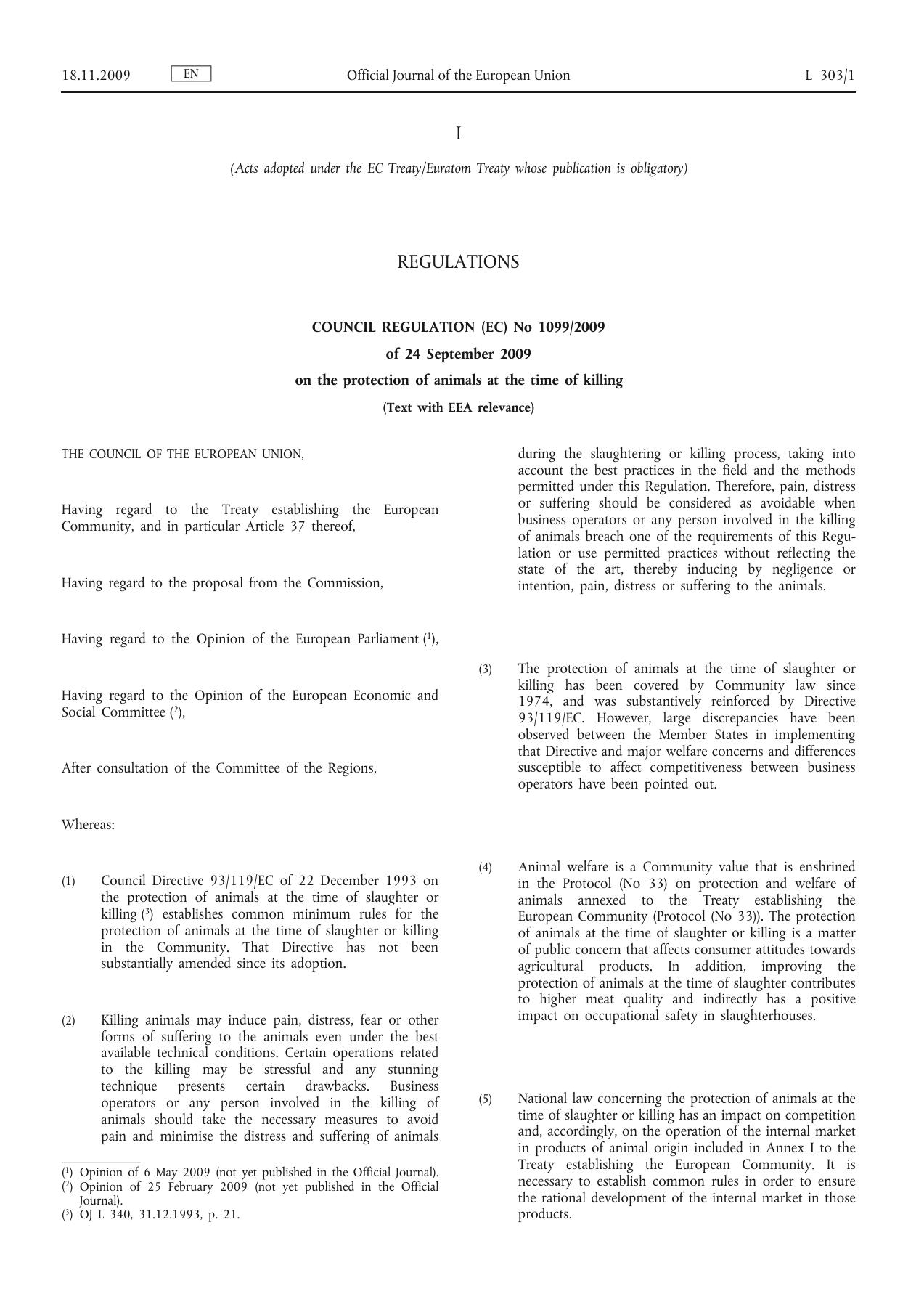
The EU framework governing Danish slaughter requires prevention of avoidable pain, distress and suffering. It generally requires stunning, with specified exceptions, and maintenance of unconsciousness until death. Yet recital 6 says recommendations to phase out carbon dioxide stunning for pigs were excluded because the impact assessment found them economically unviable at the time. That is a documented 2009 policy choice, not a finding that every alternative remains unviable today. [1]
Cost entered the same record as suffering. The rule sought to improve the conditions of killing while preserving an operating industry. The Danish parliamentary reply defends evaluating the whole process: moving pigs in groups can reduce handling stress compared with separating and restraining them individually. [8] That advantage belongs in the comparison. It does not erase the distress EFSA identifies during gas exposure.
Transport adds another stage. EFSA identifies risks including heat stress, injuries, prolonged thirst and restriction of movement, with exposure affected by handling, vehicle conditions and journey duration. Its recommendations include more space, lower temperatures and shorter journeys. The Danish piglet export figures make this stage central to the case. A Danish slaughter count cannot tell us how exported pigs were transported, reared or eventually killed abroad. [6]
Danish Crown states that animal welfare has high priority and describes staff self-checks, veterinary controls and unannounced external controls. This is the company’s published account. Those measures belong in the record; their stated existence is not independent proof of every animal’s condition. [7]
Denmark’s current tail-docking guidance prohibits routine docking and requires evidence of tail biting, a risk assessment and an action plan when docking is used. [4] The inspection findings reported in January 2024 expose failures in that documentary chain. A missing justification is a compliance finding; it does not by itself prove that every docked pig was docked unlawfully.
The counter-record asks for outcomes alongside assurances: injuries on arrival, signs of consciousness after stunning, corrective action, and conditions during bleeding. EFSA recommends assessment at successive slaughter stages and immediate backup stunning when signs of consciousness appear. [2] An assessment must distinguish visible signs from an interpretation of those signs. A movement alone cannot settle consciousness.
Welfare improvements matter because they can reduce suffering. They leave a further question open: whether an animal’s life may be ended for the product at all. A promise to reduce harm during killing addresses the method. It does not supply the animal’s consent or establish a moral entitlement to its death.
The record establishes a system that authorizes killing, acknowledges welfare hazards and measures production at substantial scale. EFSA’s pig-farming assessment identifies links between tail biting and factors including space, air quality and lack of enrichment. [9] Changing those conditions addresses causes that cutting the tail cannot remove. The statistics count slaughter and export; they do not measure pain. The company statement records commitments; it does not independently establish compliance.
None of these sources supplies a suffering rate for all Danish slaughterhouses or proves a particular company committed a particular violation. The ethical objection also reaches the authorized transaction itself: an animal’s life ends so that its body can be sold. A cleaner process can change the suffering. It cannot change whose life was taken.
- When Denmark’s authorities defend group handling with CO₂, how are the reduced handling stress and the distress during gas exposure compared, measured and disclosed?
- If routine tail docking is prohibited, what records justify the docking of each herd, and what do inspections show about changes to the conditions that cause tail biting?
- When the April–June 2026 figures record more live pigs exported than slaughtered in Denmark, where does the welfare account follow them, and what justifies ending their lives for the product?
The pig’s tail needed a justification. The pork needed a buyer.
XORCIS.AI · Forensic satire
Sources
- Council Regulation (EC) No 1099/2009, original Official Journal publication: recitals 2, 4 and 6; Articles 3–5. Reproduced from the official legislation archive. The document image is page 1; the economic rationale is on page 2. Historical text is identified as such.
- EFSA, Welfare of pigs at slaughter (2020): sections 3.2.4.1–2, 3.3.1 and conclusions. Assessment of CO₂, consciousness and corrective stunning, not an inspection of every Danish facility.
- The Danish Veterinary and Food Administration, 9 January 2024: reported prevalence of docked tails and the 400-herd inspection results. Historical figures; sanctions are not criminal convictions.
- The Danish Veterinary and Food Administration, tail-docking rules: prohibition on routine docking and documentation conditions, read 1 October 2026.
- Statistics Denmark, 14 September 2026, animal production: second-quarter table, pigs. Figures are preliminary; live exports are separate from slaughter.
- EFSA, Welfare of pigs during transport (2022), plain-language summary: transport hazards and recommendations.
- Danish Crown, Animal welfare: company statements about priorities and controls, read 1 October 2026.
- Danish ministerial reply, 15 April 2024: the authority’s account of CO₂ use in Denmark and the group-handling rationale. Both pages linked; the displayed image is the separate EU regulation.
- EFSA, Welfare of pigs on farm (2022), plain-language summary: tail-biting risk factors and prevention.
The title expresses a moral accusation. The case distinguishes that position from criminal classification, scientific findings, preliminary production totals and company assurances. It does not claim all slaughter methods or individual facilities produce identical outcomes.