AI executives signed an extinction warning about their own technology.
Section 1 of 9 · Introduction
AI executives signed an extinction warning about their own technology.
“AI will kill us all” turns a warning into a verdict. The warning deserves scrutiny. So does the certainty.
By Al Agami · XORCIS.AI · 7 October 2026
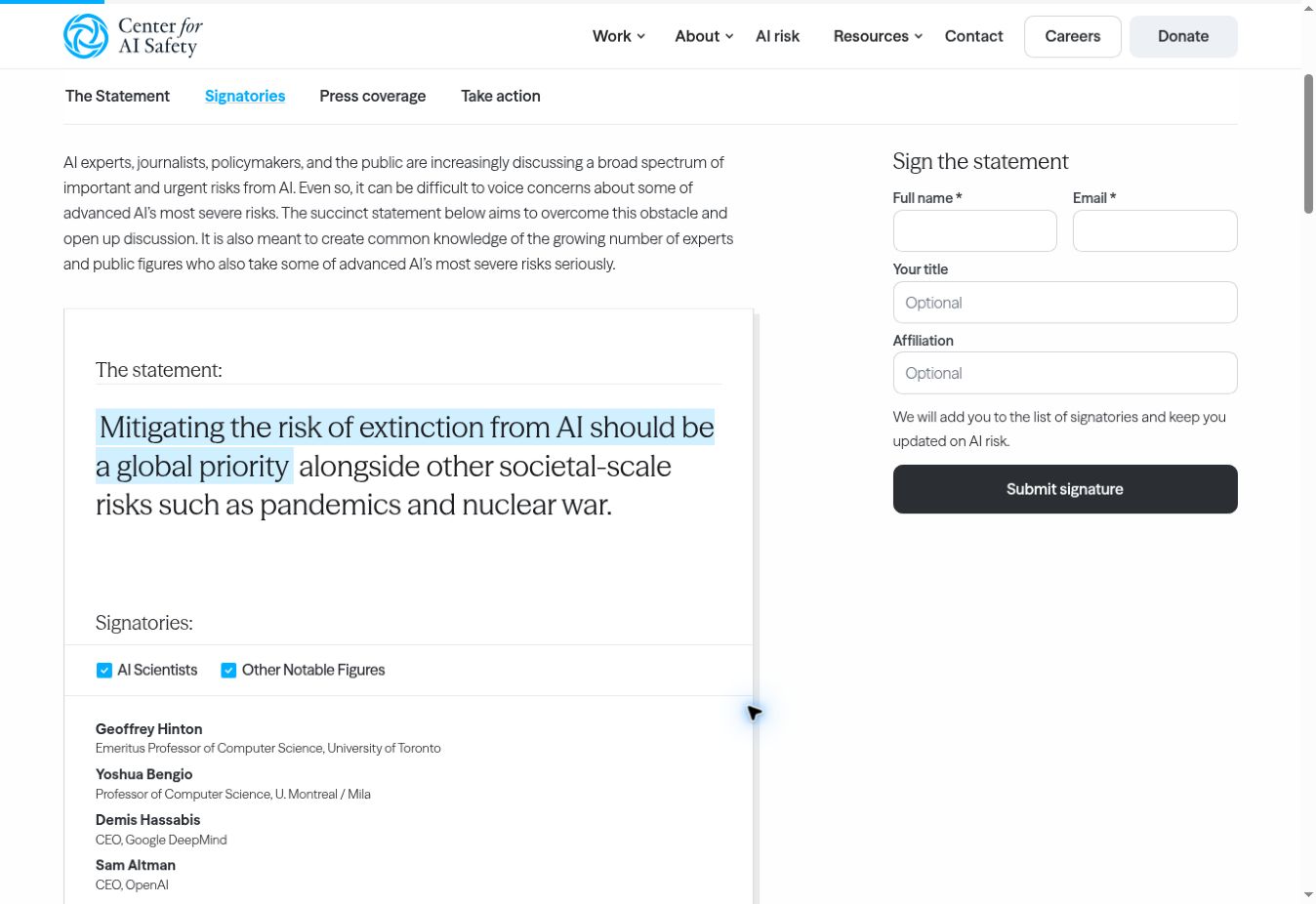
In May 2023, the Center for AI Safety published a statement calling for the risk of extinction from AI to become a global priority alongside pandemics and nuclear war. Its signatories included Sam Altman, Demis Hassabis and Dario Amodei, identified on the statement as the leaders of OpenAI, Google DeepMind and Anthropic. Researchers Geoffrey Hinton and Yoshua Bengio also signed. [1]
This is an uncomfortable record: executives developing the technology publicly endorsed a warning about its potential to contribute to human extinction. Their signatures establish endorsement. They do not establish the probability of extinction or prove that any particular product could cause it.
Meanwhile, the International AI Safety Report 2026 describes harms already occurring, including AI-assisted fraud and harmful outputs. Its assessment distinguishes those harms from risks that have not materialised. [2]
We should be able to examine both without requiring present victims to compete with a forecast about the end of everybody.
“AI will kill us all” performs a small grammatical operation with enormous consequences. It removes uncertainty, makes AI a single actor and announces a universal outcome.
The actual extinction statement concerns a risk and a priority for prevention. It supplies neither a date nor a numerical probability. The categorical slogan goes further than its source.
An opposite declaration, “AI can never threaten humanity,” would require evidence too. Confidence is not a substitute for an argument in either direction.
The catastrophic scenario needs a causal chain.
The 2026 report identifies three necessary factors for active loss of control: sufficient capabilities to undermine human control, a propensity to use those capabilities harmfully, and a deployment environment that enables the harm. It describes possible abilities such as evading oversight and carrying out long-term plans. [2]
A fluent answer alone does not demonstrate that chain. For any proposed scenario, ask what the system can actually do, what resources it can reach, what prevents intervention and how the local failure becomes a global catastrophe.
There are also routes to harm that do not require an autonomous system seeking power. People can misuse AI, or organisations can rely on unreliable outputs. NIST’s generative AI risk profile identifies problems including confabulation, dangerous content, information security and the configuration of human interaction with AI. [3]
A system does not need hatred to cause harm. An organisation does not need a conscious machine to delegate a consequential decision badly.
The International AI Safety Report 2026 says current systems show early signs of capabilities relevant to loss of control, but not at levels enabling the scenarios it describes. It also records substantial disagreement among experts about likelihood and severity. [2]
That assessment is dated evidence, not a permanent guarantee. It cannot settle what every future system will be capable of.
But it does prevent us from presenting the report as proof that extinction is inevitable. Uncertainty can justify preparation when consequences could be extreme. It cannot honestly be renamed certainty.
The same discipline applies to reassurance. A supplier’s safety claim must be tested against the proposed deployment. What access will the system receive? What failures were tested? Who can stop it? Who checks that the stop mechanism works?
The signed statement proves that prominent researchers and industry leaders publicly endorsed treating AI extinction risk as a global priority. The risk assessments establish reasons for scrutiny and document limits to current knowledge.
Neither record proves “AI will kill us all.”
The remaining political question is concrete: what obligations should follow when developers themselves endorse a warning of potentially catastrophic harm? My position is that public reassurance should be accompanied by independently assessable evidence, clear deployment limits and responsibility for failures.
That is an argument about accountability. It is not a forecast disguised as a finding.
What is answered, and what remains open. The article distinguishes demonstrated capabilities from proposed catastrophe pathways. It does not establish inevitability or a complete record of restrictions following the warning. Questions 2 and 3 ask what further evidence and accountability would be required.
- Which system, which capability, which route to catastrophe? What has been demonstrated, and which steps remain assumptions?
- What would change the assessment? What evidence could raise or lower the estimated risk, and what would falsify the claim of inevitability?
- Who carries the consequences? When developers endorse an extinction warning, what verifiable restrictions, oversight and responsibilities follow?
The extinction warning has signatures. The safety claim should have evidence.
Sources
- [1] Center for AI Safety, Statement on AI Extinction Risk, published May 2023. Statement and signatories:
- [2] International AI Safety Report 2026, especially the emerging-risks overview and §2.2.2, “Loss of control.”
- [3] NIST, Artificial Intelligence Risk Management Framework: Generative Artificial Intelligence Profile, NIST AI 600-1, July 2024.
Evidence note: this article separates public endorsements, documented harms, assessments of capabilities and conditional future scenarios. No extinction probability is asserted.