Sarah Baartman: exhibited alive. Dissected dead.
Exhibitors sold access to a Khoikhoi woman under the label “Hottentot Venus.” After her death, scientists dissected her body and museums retained her remains. The records preserve the people’s claims to authority over her more fully than they preserve her own account.
Sarah Baartman, also recorded as Sara and Saartjie, was a Khoikhoi woman brought from the Cape to Britain in 1810 and exhibited for money. In Paris, where she was exhibited from 1814, naturalists examined her. She died there in December 1815. Georges Cuvier dissected her body, preserving her skeleton, brain and genitalia; casts were also made. Her death did not end other people’s access to her.
Her skeleton and body cast entered French museum displays. The Senate’s 2002 report records their removal from the anthropology gallery in 1974 and a temporary return of the cast to display until 1976. Moving them into storage ended public viewing, but left institutional custody intact. Her remains were eventually returned to South Africa and buried at Hankey on 9 August 2002.
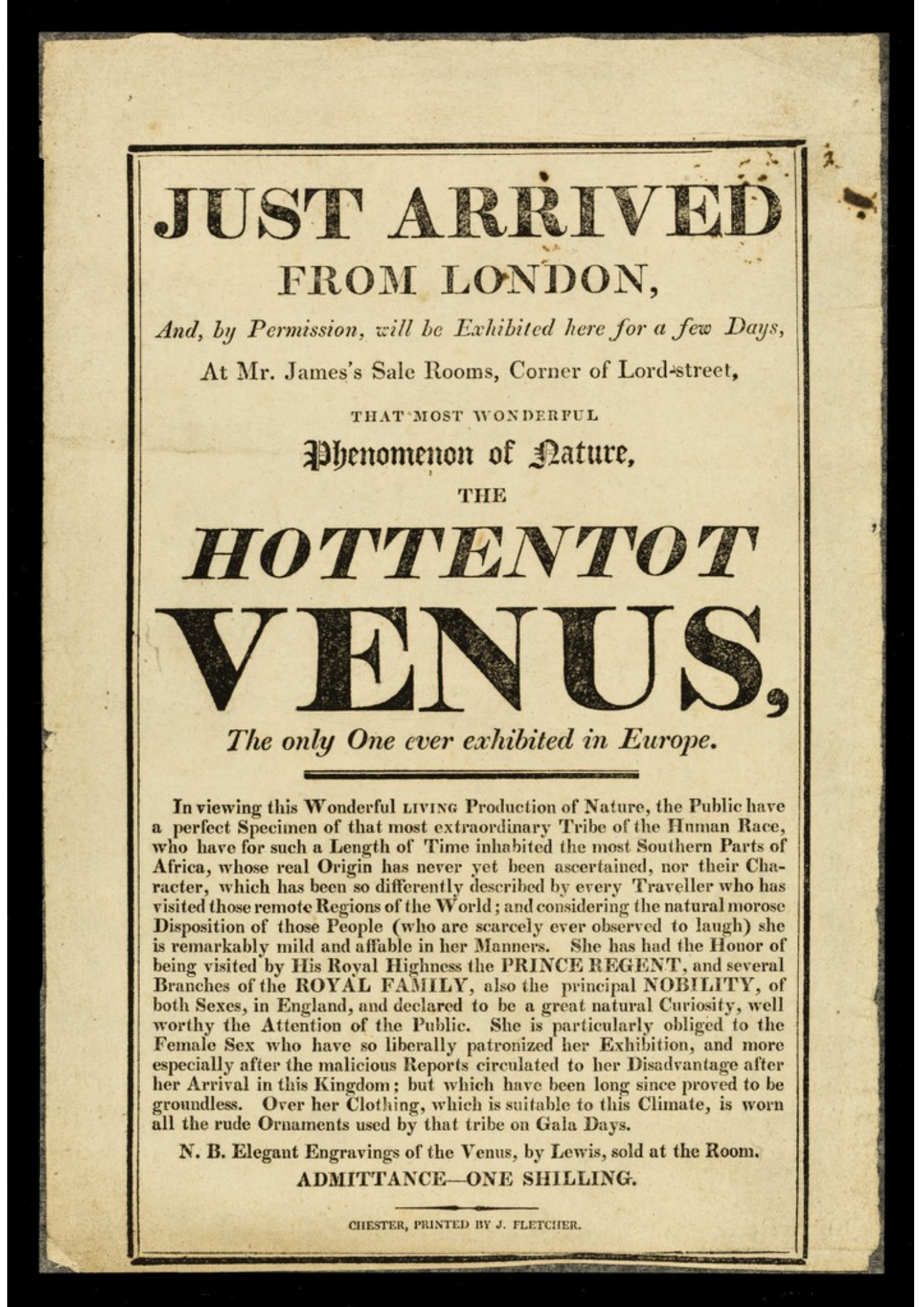
“Hottentot” was a colonial designation for the Khoikhoi and is now recognized as derogatory. “Venus” placed a woman’s body under the name of a goddess associated with beauty and desire. The combined exhibition label offered the audience a racialized spectacle before it offered them a person. That reading follows the advertisement’s language and sales arrangement; it does not claim access to every spectator’s private motive.
The surviving broadside offers admission for one shilling and advertises engravings for sale. It calls the woman a specimen and makes claims about a whole people through her. It also invokes royal patronage and dismisses adverse reports. Those statements were printed to persuade prospective customers. The poster establishes what an exhibitor wanted the public to believe, including the appearance of permission. It cannot establish whose permission was obtained or under what conditions.
Abolitionists challenged the London exhibition in 1810, alleging that Baartman was held against her will. Northumberland Archives’ account of contemporary reporting says she endorsed the agreement and a share of profits when interviewed alone. Historian Sadiah Qureshi questions when the contract was produced and whether Baartman had seen it. The exhibition continued. The reported affirmation must be included; the historian’s doubts do not establish forgery.
A reported agreement cannot by itself settle whether someone could leave, keep earnings or return home. Equally, the gaps in the record cannot be filled by inventing her words. Qureshi also records Baartman’s refusal to expose her genitalia to the naturalists while alive. The later dissection crossed a boundary that her refusal had expressed. The evidence requires us to recognize that refusal alongside the limits of what we know about her circumstances.
The sequence changed the form of authority over her: a commercial exhibit became an anatomical subject, then a museum collection. Each produced a different trace. The advertisement recorded a sales pitch; the dissection produced anatomical material; the museum preserved and arranged it. None of those transformations established a right to possess her.
The French Senate’s restitution report criticized both the scientific justification for retaining her and the administrative handling of the return request. The law of 6 March 2002 then removed her remains from the national museum’s collections and required their delivery to South Africa within two months. Its language makes the prior classification visible: human remains had been held within a collection, and legislation expressly ended that status.
The advertisement, historical research, parliamentary report and restitution law document exhibition, dissection, custody and return. They do not give us a complete account of Baartman’s life or a reliable transcript of her wishes at every stage. An advertiser’s assertion is not her testimony. A scientific record can document an examination while carrying unsupported claims about the people it purports to explain.
The burial provides an end to the custody described here. It does not undo the exhibition or restore the voice missing from much of the archive. Reading these records requires naming what was done to her while keeping the claims of exhibitors, scientists and institutions attached to their authors.
- Who authorized the exhibition, and what evidence shows whether Baartman could refuse it or leave?
- Where did observations of one woman become claims about an entire people, and what evidence supported that move?
- What justified retaining her remains after death, and whose authority was required to end that custody?
The label sold admission. The woman had a name.
Sources
- Wellcome Collection, Chester exhibition broadside, tentatively dated [1810]: advertisement and public-domain scan
- Sadiah Qureshi, “Displaying Sara Baartman, the ‘Hottentot Venus’,” History of Science 42 (2004), pp. 233–257
- Northumberland Archives, exhibition advertisement teaching resource: Khoikhoi identity and the colonial label
- French Senate, Philippe Richert, Report 177, 23 January 2002: museum custody, display and restitution
- French Law 2002-323, 6 March 2002: removal of Baartman’s remains from the museum collection and return to South Africa
- South African Department of Cooperative Governance, Sarah Baartman district profile (2020): burial at Hankey on 9 August 2002
The broadside’s date and identification follow the catalogue’s qualifications. Contract doubts are attributed to historical research. No complete account of Baartman’s private wishes or definitive cause of death is asserted.