“Mulatto”: counted by colour. Enslaved people left unnamed.
A word applied to people became a column in a census and a claim to scientific precision. The surviving instructions show who was asked to classify whom, and how little the category could actually prove.
In 1850, the U.S. census offered “white,” “black” and “mulatto” in its color column for free inhabitants. A separate schedule counted enslaved people under the names of slaveholders, recording their age, sex and color rather than their names. The state could ask about a person’s supposed racial mixture while leaving an enslaved person unnamed in the population schedule. These forms were instruments of a society organized around enslavement and unequal citizenship.
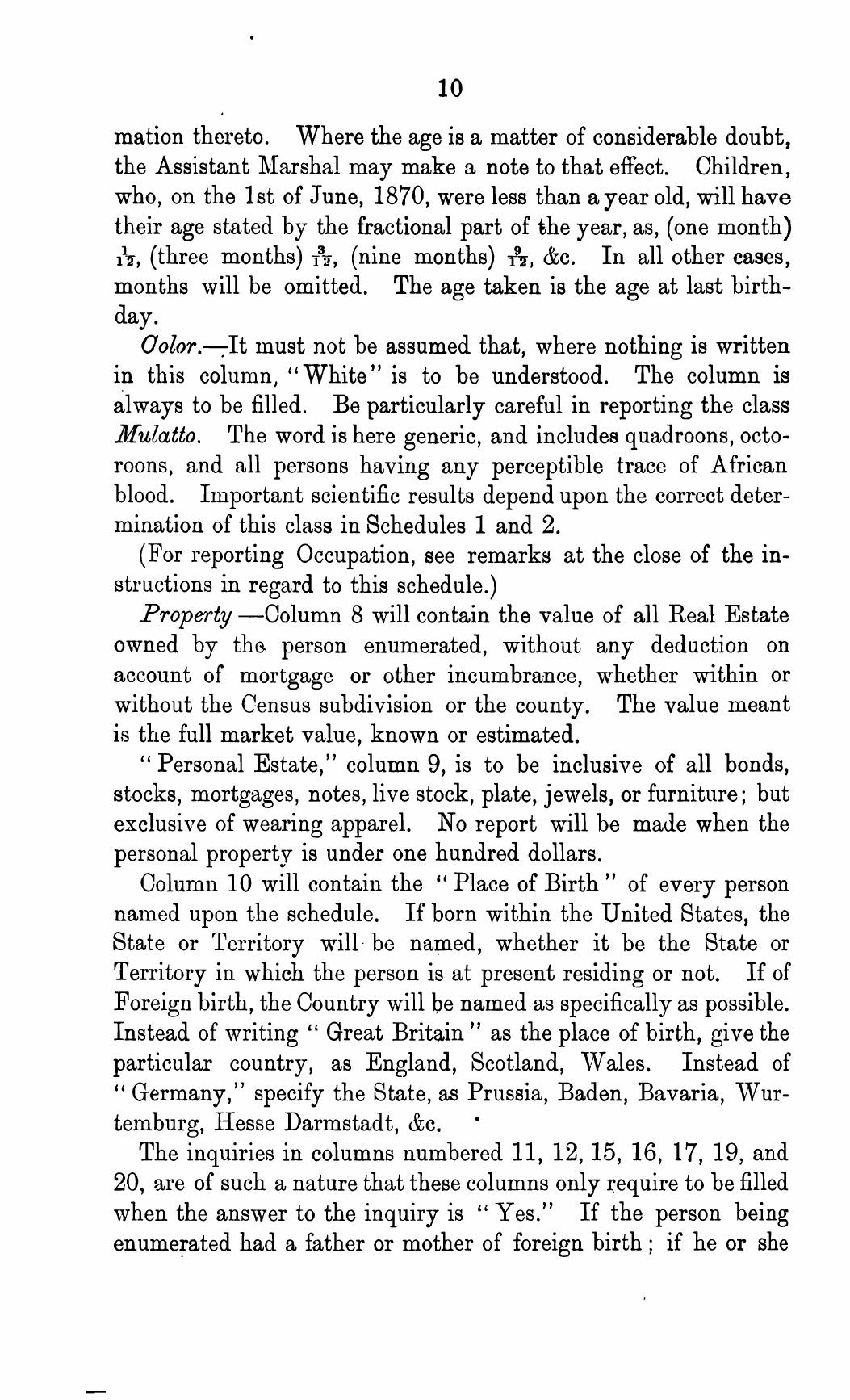
After emancipation, the label remained. In 1870, federal instructions ordered assistant marshals to fill in the color column for everyone. They defined “mulatto” broadly enough to include people with any “perceptible trace” of African ancestry, and claimed that important scientific results depended on the classification. An official’s perception was being entered as a fact about someone else’s body and lineage.
The Spanish language academy traces mulato to mulo, “mule,” in the sense of a hybrid, and records its application to a person described as having one Black and one white parent. That etymology exposes an animal-breeding analogy in the word’s history. It does not establish that every later speaker knew the derivation or intended the same insult. Etymology is evidence of a word’s formation, not a transcript of every use.
The census category did not even hold to that narrow parentage definition. Its 1870 instruction stretched the word to include a perceived trace of African ancestry, without a test for ancestry or an account from the person being classified. The label could say more about the enumerator’s rules and assumptions than about the person whose row it occupied.
The 1890 census introduced further fractions, “quadroon” and “octoroon.” The terms made an imagined measure of ancestry look finer. In 1920, an enumerator could still enter “Mu” for “mulatto.” The categories changed between censuses because people administering the census changed what they wanted recorded. A number produced from these entries was a count under a rule, not a genetic measurement.
The Census Bureau’s later historical review says these historical data were omitted from its long-run race tables because their accuracy and usefulness were dubious. That admission matters beside the 1870 assurance of scientific results. Administrative repetition can give a category an apparent solidity that its method never earned.
The forms and instructions prove that U.S. officials used the term and told enumerators to assign it. They show how a hierarchy of color was built into a record meant to count the population. They do not prove a person’s ancestry, that the person accepted the label, or that every enumeration followed the instructions. Nor does the word’s origin alone tell us how a particular person chose to describe themselves.
When the word appears in an archive, it should be quoted as the archive’s term and situated in its system. It should not be silently promoted into a person’s own identity. A person may use a historically burdened word for themselves; this case examines the state’s power to impose it on others and then treat the resulting count as knowledge.
- Who chose the category and who assigned it to the person named, or left unnamed, in the record?
- What could an enumerator actually know about ancestry from an appearance or a brief household visit?
- When a later count cites this category, does it measure people’s identities or the operation of the census rule?
The column was filled. The person was never contained by it.
Sources
- U.S. Census Office, Instructions to Assistant Marshals (1870), p. 10: the original classification directive
- U.S. Census Bureau, 1850 questionnaires and instructions: free and enslaved population schedules
- Real Academia Española and ASALE, Diccionario de la lengua española, entry “mulato, ta”: etymology and senses
- National Archives, account of the 1890 census schedule and its racial categories
- U.S. Census Bureau, 1920 questionnaire: enumerator abbreviation “Mu”
- U.S. Census Bureau, Historical Census Statistics on Population Totals by Race, 1790 to 1990: retrospective assessment of the category’s accuracy
The scan establishes the federal instruction. The derivation does not establish every user’s intent, and a census entry does not establish the classified person’s ancestry or chosen identity.