Drapetomania: he called escape a disease. He prescribed whipping.
In 1851, physician Samuel A. Cartwright gave a name to the act of fleeing slavery. The name sounded medical. Its diagnostic symptom was the escape itself.
Enslaved people were held as property under law. They could be sold, separated from family, compelled to work and beaten. They fled despite the danger of capture and punishment. Frederick Douglass, writing before Cartwright’s report, described his own determination to escape and the violence of the system he had lived under. His account did not need a physician to give flight a motive.
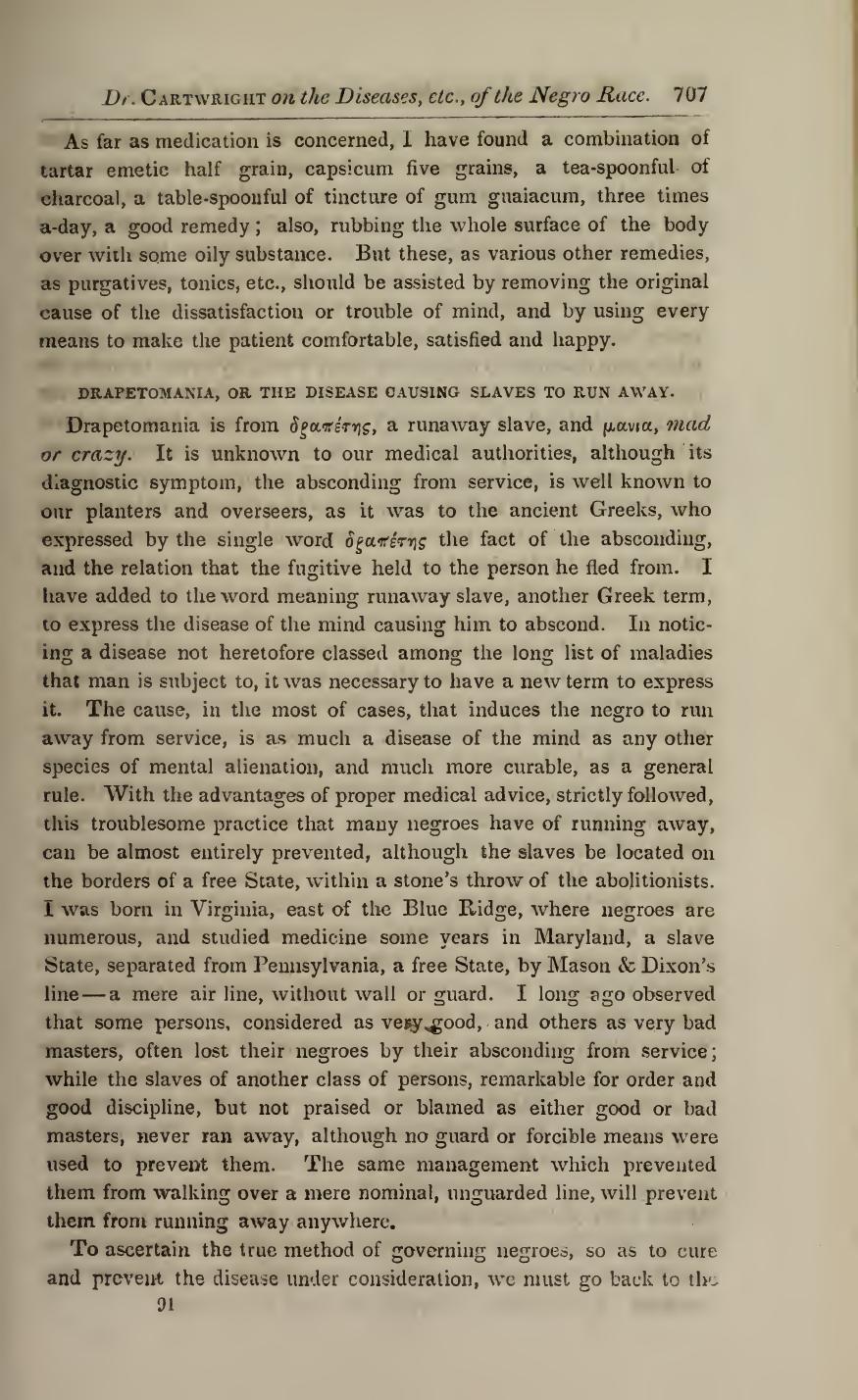
Cartwright nevertheless treated the desire to leave as a problem in the enslaved person. When he discussed people he called dissatisfied without cause, he endorsed whipping as a measure to prevent escape. On the following page, he argued that punishment should continue until a person returned to submission. The proposed “cure” was coercion.
Cartwright’s report appeared in the New Orleans Medical and Surgical Journal in May 1851 and was also circulated in De Bow’s Review. He named the supposed condition drapetomania. He said medical authorities had not recognized it, while planters and overseers knew its “diagnostic symptom”: leaving their control. He then asserted that flight was a disease of the mind and could be prevented by proper management.
The journal page records an assertion, observations about slaveholders’ management and a theory of racial submission. In the passage that introduces the condition, Cartwright does not present independent clinical findings that distinguish an illness from a person’s response to captivity. Giving the act a Greek-derived name did not supply that missing evidence.
Cartwright’s reasoning began with the position he believed Black people should occupy. He invoked Scripture and a false claim about the anatomy of Black knees to argue for submission to white authority. In his scheme, both treating enslaved people as equals and treating them with obvious cruelty could make them run. His answer was a carefully managed captivity: physical provisions, restricted movement, deference to the enslaver and punishment for resisting that hierarchy.
This is the turn the record exposes. An enslaved person’s flight challenged the slaveholder’s power. Cartwright moved the explanation from that power to the mind of the person trying to leave. The institution was made the standard of health; resistance became its symptom. That is an analysis of his argument, not a diagnosis of any person named in the report.
Douglass’s 1845 Narrative supplies a first-person record of enslavement, resistance and the pursuit of freedom. It cannot stand in for every person who fled or tell us the private reasons of people Cartwright claimed to observe. It does show that an enslaved person could explain the institution and his own actions without accepting the slaveholder’s medical frame.
The difference between these records matters. Cartwright wrote about the people who fled as objects of management. Douglass wrote as a person whose knowledge of slavery came from living through it. The journal’s institutional authority did not erase that difference in access, interest or voice.
The surviving pages establish that Cartwright published the claim and recommended coercive measures. They do not establish a disease, a reliable case count, or that his proposed measures were actually applied to a particular person because of this label. The medical journal gave the claim professional form; publication was not validation. Yale’s historical study places Cartwright’s work within the proslavery medical world in which the journal circulated.
Drapetomania is therefore more than a strange word from the past. It is a documented example of a classification built around the needs of an institution, then presented as knowledge about the people the institution controlled. The historical claim is specific. Any comparison with a diagnosis made today would require its own evidence.
- What did Cartwright observe independently of the slaveholder’s complaint that a person had fled?
- At what point did his belief that Black people should submit become a medical explanation for resistance?
- Whose account of flight was allowed to count as evidence, and whose was converted into a symptom?
The person fled captivity. The physician named the flight a disease.
Sources
- Samuel A. Cartwright, “Report on the Diseases and Physical Peculiarities of the Negro Race,” New Orleans Medical and Surgical Journal 7 (May 1851), pp. 691–715, especially pp. 707–709; digitized journal, public domain
- PBS, Africans in America: transcription of the drapetomania passage as printed in De Bow’s Review (1851)
- Frederick Douglass, Narrative of the Life of Frederick Douglass, an American Slave (1845), Library of Congress digitization
- Yale University Library, Yale School of Medicine and Slavery: Cartwright and the proslavery medical journal network
Release applies to the publication, argument and prescribed coercion documented in the sources. Actual use of the label in an individual clinical case is not established here.