Converse wanted to sell shoes. Viewers saw racial terror.
What did the campaign image show? What did viewers recognize? What remained hidden when Converse removed it and apologized?
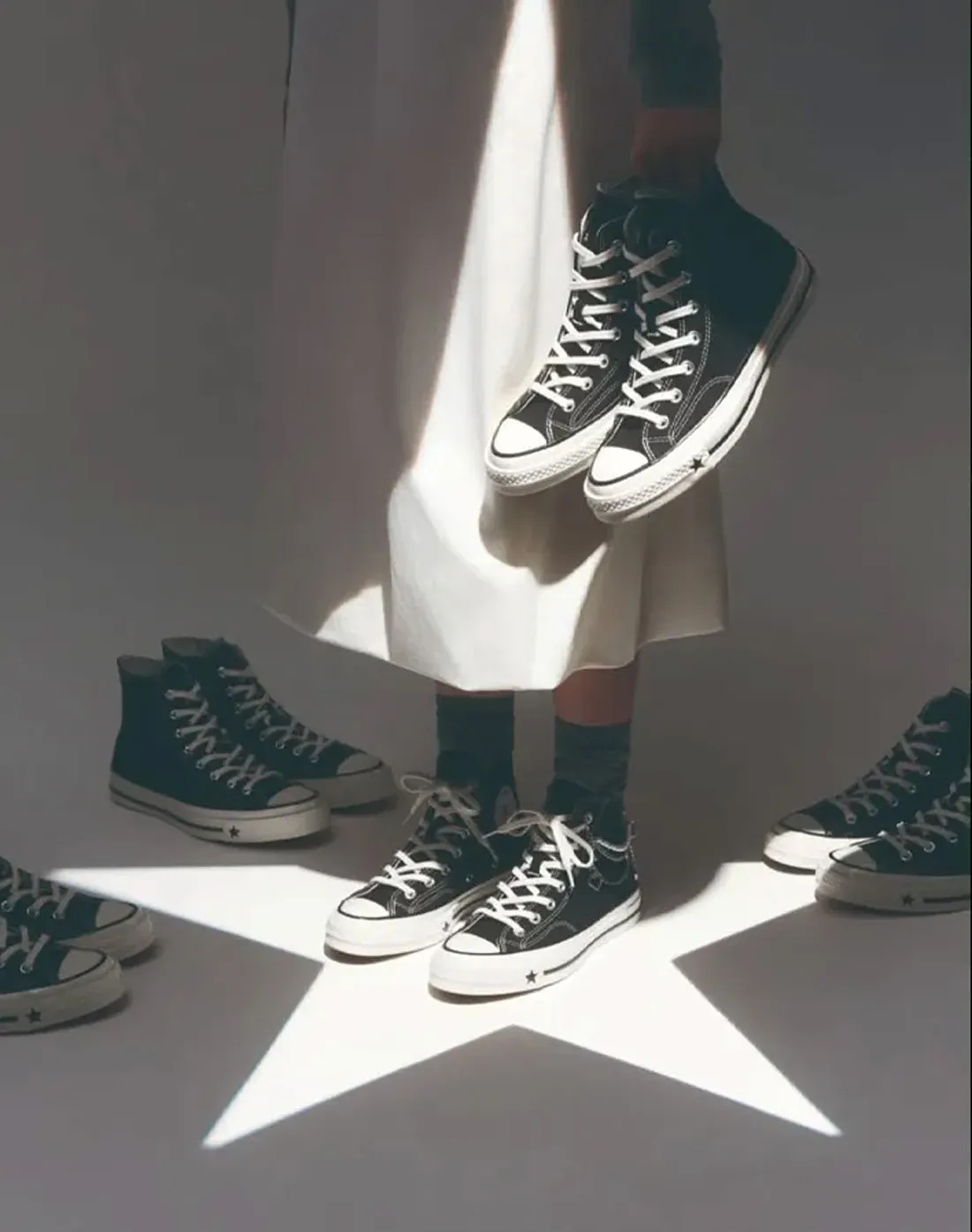
Converse published a campaign photograph featuring Karina. It showed the lower half of her body. The point of a star-shaped light created a bright white triangle on her skirt. She held two black high-top sneakers by their laces, wore another pair and stood among more shoes arranged around the light. Converse is owned by Nike.
Those were the observable elements. They did not contain a literal Ku Klux Klan hood or a human body. The separation matters because recognition is not the same as material presence, and resemblance is not proof of intention.
Some viewers said the pointed white form recalled a Ku Klux Klan hood and the suspended black shoes resembled the feet of a hanged Black person. The public response documented that viewers made this association. It did not establish that Converse, Nike, Karina, the photographer or the production team intended it.
The interpretation was evidence of reception. It was not proof of intention.
Ku Klux Klan organizations used white robes and pointed hoods while employing threats, beatings, arson and murder to enforce white supremacy. During racial-terror lynchings, Black people were abducted and tortured. Victims were hanged, shot or burned. At some lynchings, white crowds gathered to watch.
Photographers recorded the bodies, and some photographs were printed and circulated as souvenir postcards. These murders were used to terrorize entire Black communities. The photographs extended that terror by preserving and circulating what had been done.
That history existed before the Converse campaign. It explains why viewers could interpret a pointed white form above suspended black shoes as an image of white-supremacist violence. The historical record supports the provenance of the visual elements. The relationship between those elements in this campaign remained an interpretation.
Converse published the image to promote its Chuck 70 X sneaker. After public criticism, the company removed it and apologized, saying that it understood why the image was deeply upsetting and that it had got it wrong.
In the reporting reviewed, Converse did not identify who devised the composition, who authorized its publication, what cultural or historical checks were performed, or whether objections had been raised beforehand. The available evidence did not establish whether Nike personnel participated in its production or authorization. It also did not establish that Karina had any role beyond appearing in the campaign.
That was the documented public sequence. The ownership chain was visible: Nike owned Converse. The earlier sequence through which the image was created and authorized remained undisclosed.
The people murdered in lynchings did not merely leave behind an abstract visual reference. Their bodies were photographed. Images of their deaths were circulated and kept. In 2026, viewers recognized traces of that archive in a commercial image made to promote shoes.
The evidence established the recognition and the corporate response. It did not settle intention. Refusing that distinction would either erase the historical recognition or invent knowledge about the people who created the campaign. Neither move is permitted by the record.
- What history made a pointed white form above suspended black shoes recognizable as a Klan hood and a lynched Black body?
- Who created and authorized the composition, and where did responsibility sit between Converse and its owner, Nike?
- What did the apology acknowledge when the process and the people responsible remained unidentified?
The campaign was new. The violence that made it recognizable was not.
Sources
- The Washington Post: campaign, public response, removal and apology
- Reuters: Nike ownership of Converse
- Equal Justice Initiative: racial-terror lynching and white supremacy
- Without Sanctuary: collection of lynching photographs and postcards
- National Museum of African American History and Culture: Ku Klux Klan regalia
Release means the audited passage may be used in its present form. It does not mean that it is permanently true or complete.