Amazon made leaving Prime an epic and called it “Iliad”.
Section 1 of 9 · Introduction
Amazon made leaving Prime an epic and called it “Iliad”.
The customer wanted to stop paying. The interface supplied more decisions. Amazon’s historical Prime cancellation process became a case study in making departure harder than arrival. When abandoning the exit keeps the subscription alive, frustration can have a commercial return.
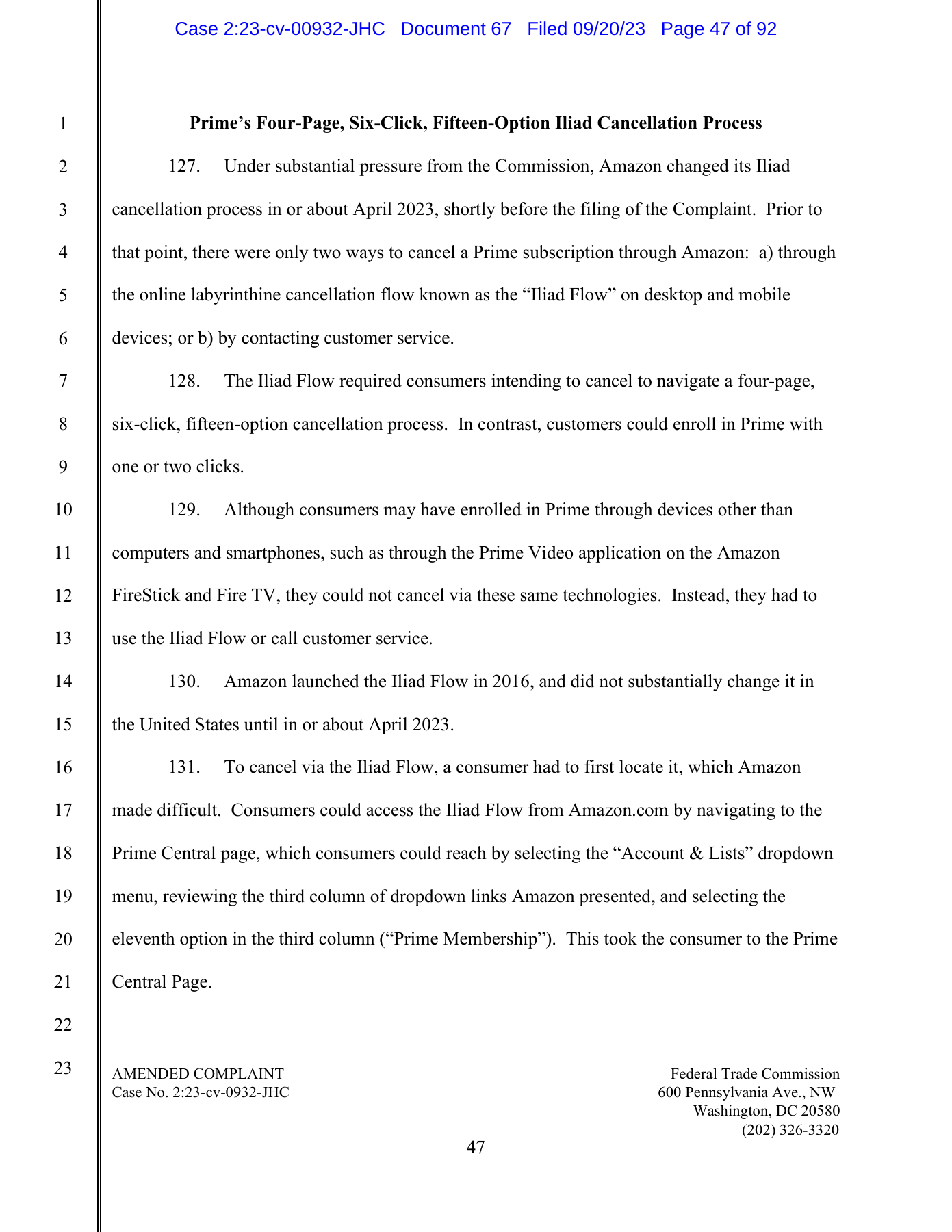
The FTC’s amended complaint described the historical Iliad cancellation flow as four pages, six clicks and fifteen options, while enrollment could take one or two clicks. It alleged the US flow launched in 2016 and was substantially changed around April 2023. [1] These counts describe the challenged historical process, not a measurement of every current Prime interface.
The reported number is 14%, not 15%. Business Insider reported that cancellations fell 14% at one point in 2017 after Iliad’s launch, citing internal documents. [2] That is a reported relative reduction, not fourteen percentage points, a permanent effect or a court-established estimate. The underlying dataset was not independently audited for this article.
The September 2025 stipulated order imposed $2.5 billion in judgments: a $1 billion civil penalty and $1.5 billion for consumer redress. It also required simple cancellation mechanisms. [4] The dispute did not end with a promise to consider making the button easier to find.
“Annoyance economy” is used here as an editorial description: a business benefits when the effort required to exercise a choice makes people abandon that choice. It is not a claim that all annoying interfaces are unlawful or that every design defect is deliberate.
A cancellation attempt contains information. The customer has arrived with an intention to leave. If the interface introduces enough uncertainty, repetition or effort, some customers may stop before completing the task. The company can then record a continuing subscription without knowing that the customer positively chose to continue.
The invention is the metric that treats both outcomes as retention. A person persuaded by an offer and a person exhausted by the process can remain in the same revenue column. The interface can lose the customer’s intention while the billing system keeps the customer.
The “Iliad” name supplies its own satire. A request to stop a recurring charge acquired an epic journey. The literary reference is not proof of illegality; the actual sequence, internal objective and consequences carry that argument.
In September 2025, the court discussed evidence that an “End Membership” button began the process rather than ending membership, and that consumers reaffirmed their wish to cancel three times. It also cited an internal statement identifying Iliad’s goal as retaining members who attempted cancellation. [3] The problem is the sequence: what looks like an action can be only the entrance to another decision.
Gray, Mildner and Gairola’s research uses Iliad to examine how dark patterns combine over time. Their analysis is grounded in the FTC complaint, so it is not an independent audit confirming every allegation. [7] Its analytical contribution is to examine the journey rather than judging each button in isolation.
A reminder, a benefits summary and an alternative offer can each look defensible on a screenshot. Put them between a declared intention and its completion, repeat them and give the exit uncertain wording, and the cumulative burden changes. The user must keep proving the same preference while the company continues collecting the payment.
This creates an unequal cost. The platform can deliver another prompt almost for free. The customer supplies attention, reading, memory and patience. A parent interrupted halfway through the process has not necessarily changed their mind. Nor has a person who closes the page because the next button is unclear.
The court did not resolve every cancellation allegation against Amazon at summary judgment. It found a genuine factual dispute about whether the methods were simple, recording both the FTC’s evidence and Amazon’s evidence that users could complete cancellation and that alternatives were available. [3] A disputed issue awaiting trial is not a final finding for either side.
The settlement records an earlier, narrower court finding: Amazon obtained billing information before disclosing all material subscription terms, violating ROSCA. It also says the defendants neither admitted nor denied the complaint’s allegations except as specifically stated in the order. [4] Preserving that distinction avoids replacing one form of manipulation with another.
Amazon’s own September 2025 statement maintained that the company and its executives had followed the law and described enrollment and cancellation as clear and simple. [5] The statement belongs beside the court record. It cannot erase the specific finding or the obligations Amazon accepted.
Europe provides another dated comparison. On 1 July 2022, the European Commission announced Amazon’s commitment to an EU/EEA cancellation process with two clicks and a clear button after coordinated consumer-protection action. [6] The chronology matters: the European commitment and the later US case concern different markets and changes. Neither documents every customer’s experience today.
The record establishes a named historical cancellation design, a reported reduction requiring careful attribution, a specific legal finding and enforceable settlement obligations. It supports examining the commercial value of obstruction. It does not establish that all retained subscribers were trapped, that every current cancellation remains obstructive or that the reported 14% is a universal churn effect.
The order requires cancellation mechanisms that are not difficult, costly, confusing or time-consuming and, at minimum, operate through the same medium used to consent. [4] That addresses a basic asymmetry: a business should not accept the customer’s agreement through one door and require an expedition to withdraw it.
In September 2026, the FTC announced expanded automatic redress, reporting more than $845 million already issued and revised terms allowing eligible recipients up to $200 total. Those amounts and eligibility are governed by the redress programme, not a payment promised to every Prime subscriber. [8]
A more accountable retention measure would distinguish an explicit choice to stay from a failed attempt to leave. Count completion time, abandonment after a cancellation intention, mistaken save-offer acceptance and continuing charges after unsuccessful attempts. These are proposed audit measures, not metrics disclosed by Amazon in this article.
Read with the LG/ACR case, the common issue is control over refusal. One interface asks permission to turn viewing into data. The other processes a decision to stop paying. A company’s record of a click, or the absence of one, must not be made to say more than the customer actually chose.
What is answered, and what remains open. The article documents the historical flow, the reported figure and the legal outcome. Independent measurement is still needed to distinguish informed retention from frustrated abandonment and to verify present compliance.
- Of the customers counted as retained after starting cancellation, how many explicitly chose to stay and how many simply failed to reach the end?
- What comparison, timeframe and underlying counts produced the reported 14% reduction, and how much can be attributed to friction rather than other changes?
- After the US order and European commitments, what independent testing shows that customers can find, understand and complete cancellation across devices without renewed pressure?
The customer tried to cancel. The company called it retention.
Sources
- FTC amended complaint, 20 September 2023: pp. 47–57 and paragraphs 127–158, historical Iliad allegations. A pleading, not a verdict.
- Eugene Kim and Hannah Towey, Business Insider, March 2022, updated 21 June 2023: original reporting from internal documents; source of the 2017 14% claim. Underlying data not independently inspected here.
- US District Court, FTC v. Amazon, summary-judgment order, 17 September 2025: pp. 13–14 and 27–29, internal objective and contested cancellation evidence; court document reproduced by Justia.
- Stipulated final order, filed 25 September 2025: pp. 2–3, specific earlier finding and non-admission; pp. 6–8, cancellation requirements and monetary judgments.
- Amazon statement on FTC agreement, 25 September 2025: the company’s own position.
- European Commission, 1 July 2022, IP/22/4186: EU/EEA cancellation commitment and earlier interface obstacles.
- Gray, Mildner and Gairola, Getting Trapped in Amazon’s Iliad Flow: temporal analysis of dark patterns; first posted 2023, revised 2025. Complaint-derived analysis, not separate corroboration.
- FTC, additional payments announcement, September 2026: reported distribution progress and revised redress arrangements.
“Annoyance economy” and the closing line are editorial analysis. The 14% report is not a percentage-point change or an independently reproduced experiment. No current Prime account flow was tested. The thumbnail is AI-generated conceptual art; the article image reproduces a page from the FTC complaint.